Sommaire
Brittany Ferries restructuring
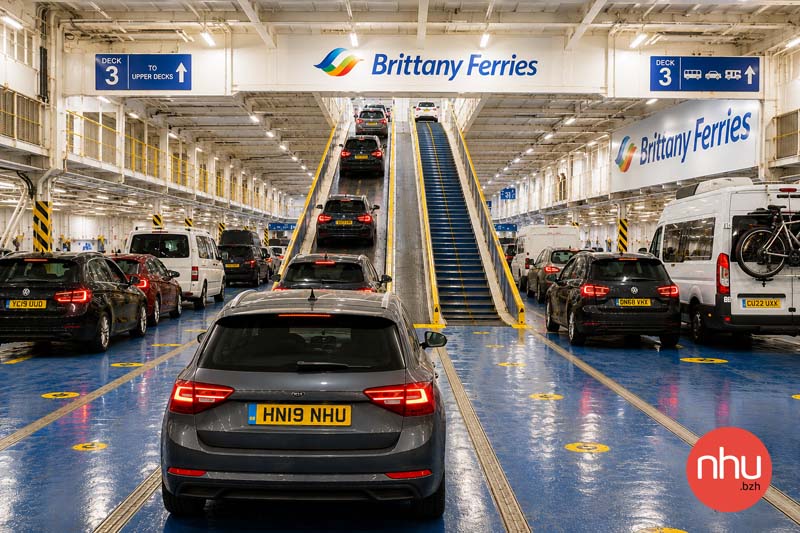
Brittany Ferries 2026 will be marked by a major reorganisation of the company’s network from the autumn. Two cross-Channel routes are set to disappear and two vessels will be sold, significant decisions for a company that has connected Brittany, England, Ireland, France and the Iberian Peninsula for more than half a century.
Yet Brittany Ferries is not withdrawing from the Channel, the Celtic Sea or the Irish Sea. Instead, it is reallocating resources towards routes it considers more sustainable. Nevertheless, the restructuring highlights a worrying reality: the company is simultaneously dealing with the continuing consequences of Brexit, lower traffic levels, repayments on its Covid-era debt and a substantial carbon bill.
Which Brittany Ferries routes will close in 2026 ?
The first closure concerns the route between Portsmouth and Le Havre in Normandy.
Brittany Ferries plans to end the service in October 2026. Operated as an economy service since 2014, the daily crossing is no longer considered financially sustainable.
The company will also close its long-established Poole-Cherbourg route in November. Representatives of crew members contacted by NHU Bretagne have expressed their deep concern over the decision, stressing that it is difficult to understand for passengers, seafarers and local representatives alike.
However, Brittany Ferries is not abandoning Cherbourg as a destination from England. A new daily service from Portsmouth will replace the Poole connection, meaning that the Normandy port will retain a regular link with the British coast.
Cherbourg-Rosslare will also continue to connect Normandy with Ireland.
Only the vessel operating the route will change. This is an important distinction, as some initial reports created the impression that this strategically important Ireland-France connection would disappear.
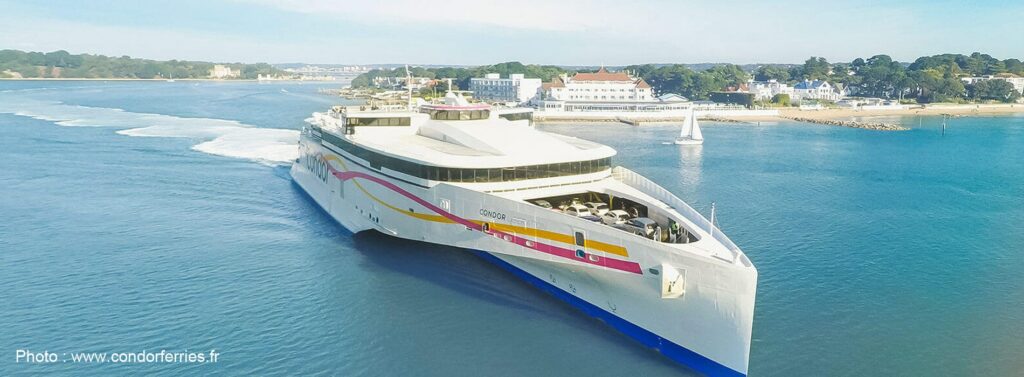
Services involving Guernsey will also be reorganised. From November, Islander will operate a triangular Portsmouth-Guernsey-Cherbourg-Portsmouth service. The fast ferry Voyager will continue to connect Poole with Guernsey, with the possibility of travelling onwards to Saint Malo / Sant Maloù in Brittany.
Why are Barfleur and Cotentin being sold ?
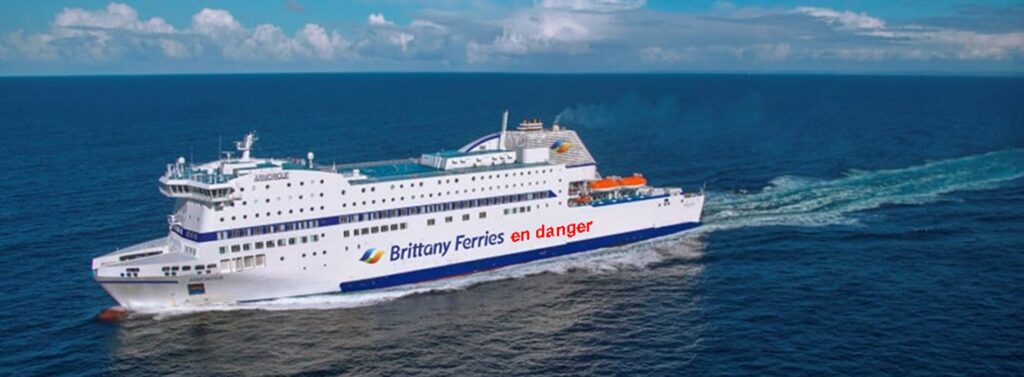
The Brittany Ferries 2026 reorganisation also includes the sale of two vessels. The first is Barfleur, which entered service in 1992 and has been closely associated with the Poole-Cherbourg route for more than three decades.
Brittany Ferries announced its sale alongside the closure of the route in November 2026. However, the company has not presented the vessel’s age or any technical inability to continue operating as the reason for the decision.
Crew members from Barfleur have told NHU Bretagne that the vessel remains fully operational, well suited to the particular requirements of the route and capable of continuing in service. Its sale therefore appears above all to be an economic and strategic decision within the wider restructuring of the network.
The second vessel to be sold is Cotentin, built in 2007 and currently used on the Cherbourg-Rosslare route. The route itself will remain in operation with another vessel.
Brittany Ferries wants to concentrate its activities around a cleaner and more efficient fleet while reducing operating costs. Selling vessels therefore provides more than an immediate financial return: it should also reduce future expenditure.
The decision forms part of a much wider transformation. Five new ferries have joined the company’s fleet over the past five years. Two LNG-electric hybrid vessels entered service in 2025, combining liquefied natural gas, electric batteries and energy-management systems.
How did Brittany Ferries reach this point ?
There is no single explanation for the company’s present situation.
First, the effects of Brexit continue to weigh on cross-Channel trade and travel. Administrative procedures have increased, while travel habits and logistics flows have changed.
According to figures released by the company, freight traffic remains around 20% below its 2019 level. Passenger numbers are approximately 15% below the years preceding Brexit and the Covid pandemic.
Brittany Ferries is also still repaying the government-backed loan taken out during the health crisis. Almost half of this debt has already been repaid, but tens of millions of euros remain due by 2030.
Higher energy costs and weaker-than-expected demand have added further pressure. Bookings for the 2026 season were reportedly around 5–6% below budget forecasts. For a ferry company, every route operating below the required load factor becomes increasingly difficult to maintain.
Taken together, these pressures explain the decisions now being implemented. Brittany Ferries is choosing to consolidate its strongest crossings rather than maintain its entire network at a loss. It may be a prudent strategy, but it also illustrates the continuing fragility of the cross-Channel ferry market.
Brittany Ferries in figures
Brittany Ferries operates 13 vessels on its main network. The company also owns 51% of Condor Topco, whose fleet includes Liberation, Clipper, Goodwill, Voyager and Islander.
Two new vessels joined the fleet in 2025: Saint Malo in February and Guillaume de Normandie in April. Both combine LNG propulsion with electric batteries.
The company employed 2,679 full-time-equivalent staff in 2025, including 1,780 seafarers and 899 shore-based employees. During the peak season, staffing rises to 3,029 people, including 2,088 seafarers.
Agricultural shareholders hold 73.21% of the company’s capital, CMA CGM Participations 12%, Breton chambers of commerce and industry 10.52%, and other shareholders 4.27%.
During the 2024–2025 financial year, the group carried 2,429,927 passengers, including Condor Ferries operations, together with 881,888 cars, camper vans and other passenger vehicles and 193,903 freight vehicles. A total of 6,476 crossings were operated during the year.
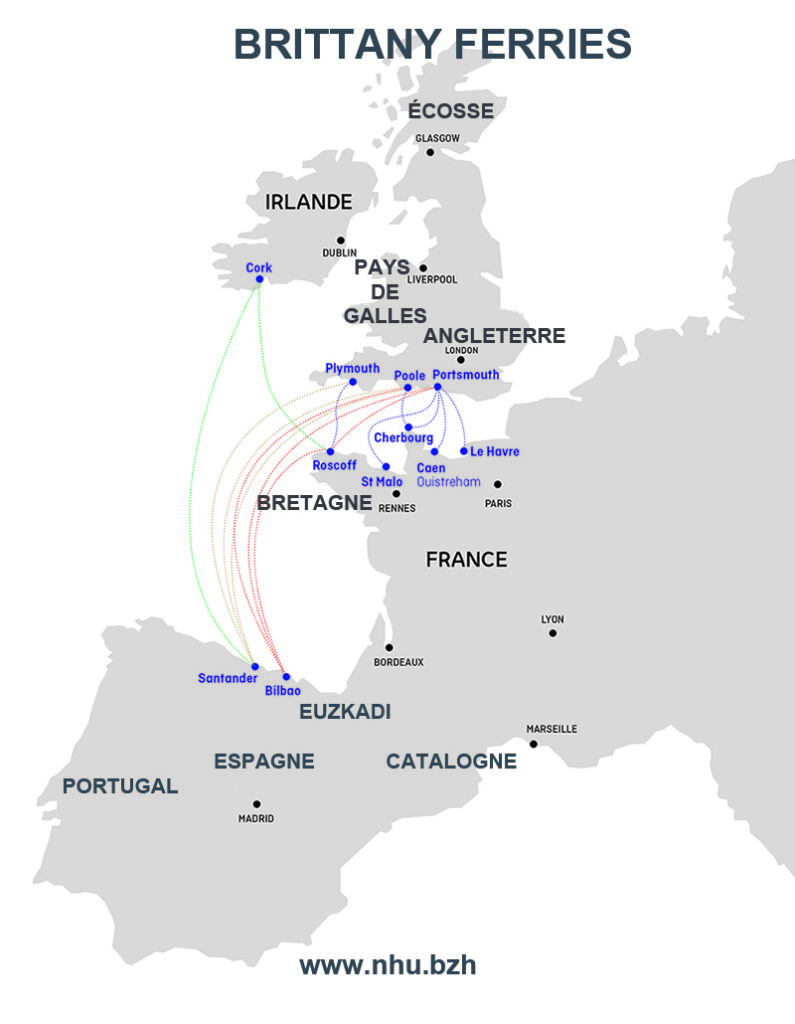
The network includes 14 sea routes connecting Brittany, England, France, Ireland, Spain and Guernsey, serving 13 ports: Roscoff / Rosko, Saint-Malo / Sant Maloù, Cherbourg, Caen-Ouistreham, Le Havre, Guernsey, Plymouth, Portsmouth, Poole, Cork, Rosslare, Santander and Bilbao.
Consolidated turnover reached €615.02 million in 2025, including Condor Ferries. These figures also illustrate the importance of Brittany’s wider economy.
Why is the carbon bill such a paradox ?
The European Union Emissions Trading System, or ETS, is progressively making maritime operators pay for their carbon dioxide emissions. Its objective is legitimate: accelerating the decarbonisation of heavily polluting industries.
However, Brittany Ferries estimates that its ETS bill will reach around €27 million in 2026. That cost comes just as the company has invested heavily in a lower-emission fleet. Brittany Ferries argues that the system does not sufficiently recognise investments already made to reduce emissions.
The United Kingdom is also introducing its own emissions trading scheme for shipping. Its initial cost is expected to remain relatively limited, but it could rise quickly. Eventually, the combination of British and European carbon charges could represent close to €40 million a year for the company.
This creates an obvious paradox.
Brittany Ferries is committing substantial capital to modernising its ships, yet those investments do not protect it from an immediate financial burden that could reduce its ability to invest further.
The issue is not whether shipping should pay for its carbon emissions. Rather, a coherent environmental transition should provide greater recognition for companies that are genuinely renewing and decarbonising their fleets.
Otherwise, regulation risks weakening some of the operators making the greatest investments while indirectly benefiting less demanding competitors. The question is particularly relevant at a time when the Atlantic Ocean and Celtic Sea are themselves undergoing significant environmental change.
Is Brittany Ferries competing on a level playing field ?
Brittany Ferries also points to competition from the Dieppe-Newhaven service when explaining its decision to close Portsmouth-Le Havre.
That route receives public funding. Brittany Ferries argues that subsidies allow a loss-making service to continue operating under conditions with which a commercial competitor cannot sustainably compete.
Legal challenges remain under consideration in Brussels. Brittany Ferries says it nevertheless kept Portsmouth-Le Havre operating for as long as possible. Its closure therefore raises a wider question about competition between ferry operators working under different economic conditions.
Social standards add another dimension. For several years, Brittany Ferries has campaigned against the employment of seafarers under conditions substantially below French social standards. Such social dumping directly affects prices and makes it harder for companies maintaining higher employment standards to compete.
Brittany Ferries itself is not entirely free from contradiction.
It has occasionally operated foreign-flagged vessels employing staff under different social regimes. This does not remove the wider problem, but it means the company cannot be presented as beyond criticism.
Why does Brittany Ferries remain strategically important to Brittany ?
The story of Brittany Ferries began in Roscoff / Rosko, on Brittany’s northern coast. In 1972, Breton vegetable growers wanted direct access to the British market. The first commercial crossing took place in January 1973 with a single freight vessel.
From those modest agricultural beginnings emerged one of Europe’s major ferry operators. The maritime relationship between Brittany and the British Isles is much older, however. Similar links continue to inspire projects today, including initiatives seeking to revive traditional maritime trade between Brittany and Wales.
Brittany Ferries has played a significant role in opening Brittany to international trade and travel. It carries passengers, vehicles and goods between several Atlantic and Channel destinations. These connections also contribute to Brittany’s growing attractiveness to international visitors, particularly from Britain and Ireland.
Its name matters too. Every day in British, Irish and Spanish ports, the words Brittany Ferries remind millions of travellers of the existence of another country on Europe’s Atlantic coast: Brittany.
This apparently simple presence has wider significance.
Brittany’s international visibility remains surprisingly limited in the English-speaking world, where the country is still too often reduced to tourism, landscapes and traditional culture rather than presented in all its economic, political and social dimensions.
Over recent years, the company has also placed greater emphasis on that Breton identity. Its expansion into the Channel Islands reinforces this international dimension.
The acquisition of a controlling interest in Condor Ferries extended its network around Guernsey, and the new organisation planned for November 2026 is intended to make these services more coherent.
Brittany Ferries also supports maritime employment, port activity and significant economic exchanges. It therefore occupies a unique place in Brittany’s maritime economy. Its financial health matters far beyond its shareholders.
Does this restructuring signal a long-term retreat ?
The announced closures are significant. They will reduce travel options for British passengers, particularly those accustomed to the Poole-Cherbourg connection, and will result in the sale of two well-known vessels.
But they do not mean that Brittany Ferries is abandoning its historic cross-Channel network. The restructuring looks more like consolidation than a general withdrawal.
Brittany Ferries is sacrificing weaker routes in an attempt to protect the wider network. The strategy could succeed if passenger and freight traffic recover and if newer vessels deliver the expected reductions in operating costs.
Nevertheless, the warning signs should be taken seriously. A strategically important Breton shipping company finds itself under pressure despite more than half a century of development and substantial investment in greener ships.
Its future will depend on its own strategic decisions, but also on more coherent European, British and social rules. For Brittany, this is therefore a company worth watching closely.
Brittany Ferries 2026 is ultimately about more than the closure of two routes.
Brittany Ferries is more than a transport operator: it remains one of Brittany’s most important direct links with Britain, Ireland and Europe’s Atlantic seaboard.
Main source: Brittany Ferries official statement, 30 June 2026.
Header image generated by ChatGPT

Support NHU Brittany by HelloAsso
Support NHU Brittany by PayPal
Support NHU Brittany by Tipeee