

Sommaire
Tabula rasa: rebuilding France from its regions
France’s decisive political break did not come in 1789 alone. On 14 July 1790, the Fête de la Fédération still celebrated a union of provinces and communities. The deeper shift came in 1791–1792, when power began to be concentrated in Paris through an increasingly vertical system. The Terror, the empires, the restorations and successive republics changed the regime, but not its underlying architecture.
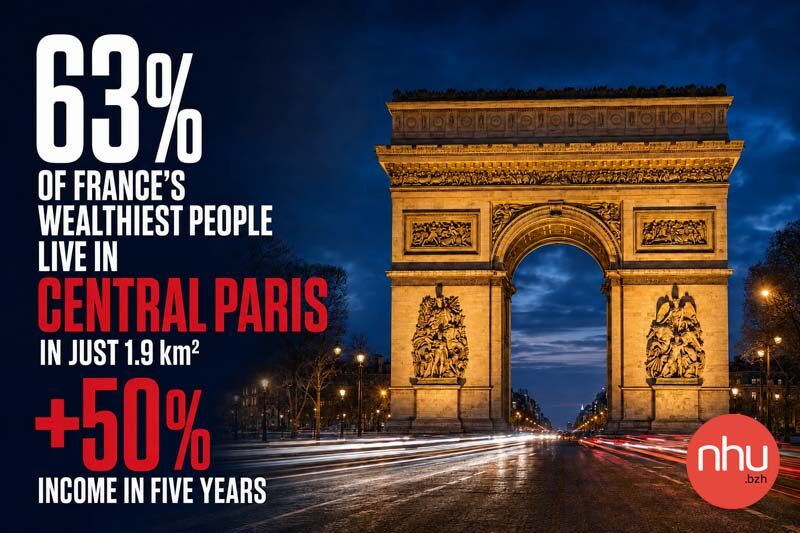
More than two centuries later, France remains governed through a pyramid whose summit is Paris. Around 1.6 million strategic decision-making jobs exist across the country, yet roughly 860,000 are concentrated in central Paris, an area of barely 1.9 square kilometres. Ministries, the headquarters of every CAC 40 company and the main financial institutions reinforce this exceptional concentration of influence.
For readers outside France, this is the essential point: French centralism is not simply a large capital dominating national life, as London or Dublin may sometimes do. It is an administrative culture in which legitimacy, finance and decision-making continue to flow from the centre to the regions. The result is a country that speaks constantly of equality while organising profound geographical inequality.
An oversized state that can no longer govern effectively
This concentration has not produced simplicity. On the contrary, layers of central administration, prefectures, regional departments, agencies and inter-municipal structures have accumulated. Each level supervises another, while responsibility becomes increasingly difficult to identify.
France now has one of the highest levels of public spending and taxation in the developed world. Yet hospitals, schools, prisons, transport and other public services remain under severe pressure. The contradiction is striking: the state consumes vast resources, but its complexity often prevents it from acting quickly or locally.
The railway system offers a clear illustration. As NHU Brittany has previously shown in a comparison between Brittany and Wales, infrastructure planned from a distant capital tends to prioritise links with that capital rather than connections within the country itself. Brittany is connected to Paris, but its own north–south links remain inadequate.
Why do France’s major parties avoid the question?
Polls have repeatedly indicated strong public support for a more federal France. One recent survey put that support at 71 per cent. Nevertheless, no major French party makes federalism a central proposal.
The explanation may lie in the system itself. Political parties, national media, senior civil servants and major economic interests are all structured around Paris. Challenging centralism would mean challenging the environment in which national careers are built. Even parties that present themselves as radical usually demand more state intervention, not a transfer of power away from the capital.
Meanwhile, the republican motto of liberty, equality and fraternity is displayed across the country. Yet formal equality can conceal a very unequal distribution of power. According to the figures highlighted by Jean Ollivro, 63 per cent of the wealthiest French people live in central Paris, where incomes rose by 50 per cent in five years.
A different vision: trust the regions and their people
Bretagne Prospective starts from the opposite principle: trust. It argues for decisions to rise from local communities rather than descend through a chain of administrative control. Federalism does not mean that every level does the same thing. It means that each level has clearly defined responsibilities and the freedom to exercise them.
This distinction matters to international readers. Devolution, federalism and decentralisation are not interchangeable. French decentralisation has often transferred duties without transferring genuine political or financial autonomy. Devolution goes further: it recognises that decisions affecting Brittany should be made in Brittany whenever possible.
That argument also places Brittany within a wider European debate. Our analysis of Brittany’s identity, culture and political reality in Europe shows how unusual the French model has become when compared with Scotland, Wales, Flanders, the Basque Country or the German Länder.
The forgotten strength of the historic pays
Below the regional level, France still contains hundreds of historic pays: coherent local areas shaped by geography, trade, culture and everyday life. Fernand Braudel underlined their age and permanence. They are not abstract administrative zones; they are places with which people identify.
In Brittany, these pays remain visible in social networks, economic activity, language, music and local loyalties. They connect towns with their surrounding countryside and provide a natural scale for cooperation. For a time, legislation recognised them as areas where local projects could be designed collectively. Later reforms weakened that approach in favour of more technocratic inter-municipal bodies.
Yet these historic units could form the foundations of a more responsible system. A strong Brittany need not reproduce Parisian centralism on a smaller scale. Power can be devolved both to Brittany and within Brittany.
Local wealth that Paris rarely sees
At this level, the vitality of society becomes obvious. Business clubs connect entrepreneurs. Local newspapers cover issues ignored by national media. Associations sustain cultural, sporting and social life. Environmental initiatives are built on detailed knowledge of rivers, coastlines, soils and communities.
Much of this activity is practical rather than ideological. People cooperate because they share the same place and face the same problems. It is here that trust is created, projects become tangible and responsibility has a human face.
A remote administration often measures such activity imperfectly because it does not fit neatly into national programmes. However, these networks are not peripheral. They are part of the country’s economic and social foundation.
France’s regions remain under permanent supervision
French regions have elected councils, but their freedom remains tightly restricted. Their powers are defined in Paris, their finances are constrained and the prefect represents the central state alongside them. New coordinating structures regularly appear, adding supervision instead of clarity.
This is why France’s model should not be confused with devolution in the United Kingdom or federalism in Germany. Brittany has no parliament, no legislative autonomy and no special constitutional status. Even the existing administrative region excludes Loire-Atlantique and Nantes, Brittany’s historic capital and principal economic centre.
For a concise introduction to the historical background, readers can consult the history of Brittany from a Breton point of view.
Administrative borders without historical coherence
The regional map imposed by Paris illustrates the problem. Names such as Grand Est and Pays de la Loire describe administrative constructions rather than communities with a shared historical identity. Alsace has been absorbed into a vast eastern region. Loire-Atlantique has been separated from Brittany. Poitou and the Vendée have been divided and attached to larger units whose boundaries are difficult to explain.
The language itself reveals the viewpoint. Grand Est means “Great East”, but east of what? The answer is Paris. In the same way, Brittany is routinely presented as part of “western France”, as if its defining feature were its position relative to the capital.
Such boundaries weaken identification and democratic interest. People are less likely to engage with institutions whose names and borders do not correspond to anything they recognise in history, geography or daily life.
Brittany is not the western edge of Paris
Brittany is a European peninsula with its own history, languages, maritime economy and Celtic connections. It cannot be understood simply as the western margin of a state organised around Paris. Its future depends on relationships across the Atlantic Arc as much as on a radial connection with the French capital.
This international perspective is not a rejection of cooperation. It is an argument for a different kind of cooperation: one between mature political communities that can choose their priorities. NHU Brittany has explored this approach in articles arguing that Europe’s future can be both national and federal and examining a federal Europe of nations.
Brittany, the Loire Valley and Normandy: three revealing cases
The administrative region called Bretagne contains only four of Brittany’s five historic departments. Removing Loire-Atlantique also removed Nantes and much of the country’s economic and maritime weight. For an international comparison, it resembles defining Catalonia without Barcelona.
The Loire Valley offers another example. The river and its cultural landscape form a world-renowned historical whole, recognised by UNESCO, but French administration divides that coherent space between regions with confusing and overlapping names.
Normandy demonstrates the opposite possibility. Long divided into Upper and Lower Normandy, it was reunited administratively in 2016. The new region corresponds to a name and historical reality understood both by its inhabitants and abroad. That clarity strengthens tourism, economic promotion and collective confidence.
Normandy shows what political clarity can achieve
Normandy did not have to invent a brand detached from its history. It could use an identity already recognised throughout the world. Once the administrative border aligned with that reality, institutions, businesses and cultural bodies gained a clearer framework in which to cooperate.
Brittany has been denied the same elementary coherence. Its reunification would not solve every political or economic problem, but it would remove a structural contradiction. A country cannot be expected to plan confidently when its principal city and one fifth of its population are placed outside its official region.
Reunification must therefore be linked to genuine devolution. Redrawing a boundary without transferring decision-making power would leave the deeper centralist model intact.
Rebuilding France from the bottom up
A durable alternative begins with real regions, recognised by history and geography, and with living pays that organise cooperation at a human scale. It requires clear responsibilities, financial autonomy and democratic accountability. Above all, it requires the central state to trust people outside Paris.
This is not a call to dismantle every common institution. A federal or genuinely devolved France would still need shared policies and solidarity. But solidarity should not mean permanent control, and equality should not mean uniformity.
For Brittany, the question is increasingly direct: should decisions continue to be filtered through Paris, or should Brittany be able to shape its own future? The wider case for a Brittany in control of its destiny is part of this democratic European debate.
French centralism has reached an impasse. Rebuilding confidence will require the opposite movement: from the bottom up, from lived communities to democratic institutions, and from control to responsibility.
Adapted for an international readership from an article by Jean Ollivro, originally published by Bretagne Prospective.
Support your independent Breton media
NHU Brittany remains independent thanks in part to its readers’ support. You can support NHU Brittany through HelloAsso or make a donation via PayPal.

Support NHU Brittany by HelloAsso
Support NHU Brittany by PayPal
Support NHU Brittany by Tipeee



1 commentaire
You point the « forgotten strengh of historic pays » out.
Forgotten, yes.
Because the « historic pays » you mention dont exist anymore since 500 years.
Regarding Brittany, the « pays » you mention has been built in 851 thanks to a military battle.
This « pays » has kept two historical languages : breton and gallo.
You link weaken identification and democratic interest to daily life.
The actual reality of Loire-Atlantique regional train connections is only 20% with Brittany.
You mention the economic and maritime weight of Nantes. You compare the importance of Nantes for Brittany with Barcelona for Catalonia.
Can we imagine l’Hospitalet de Llobregat, Terrassa, Badalona ou Sabadell as capital of Catalonia.
It would be what would happen with Rennes as capital of Brittany including Loire-Atlantique. This is totally unacceptable for Loire-Atlantique citizen.
Regarding Loire Valley and UNESCO, this recognisation is only for tourism purpose.
Loire-Atlantique is not interested by this kind of label wich would limit its capacity for setting-up supplementary industrial facilities for economic and employment expansion.