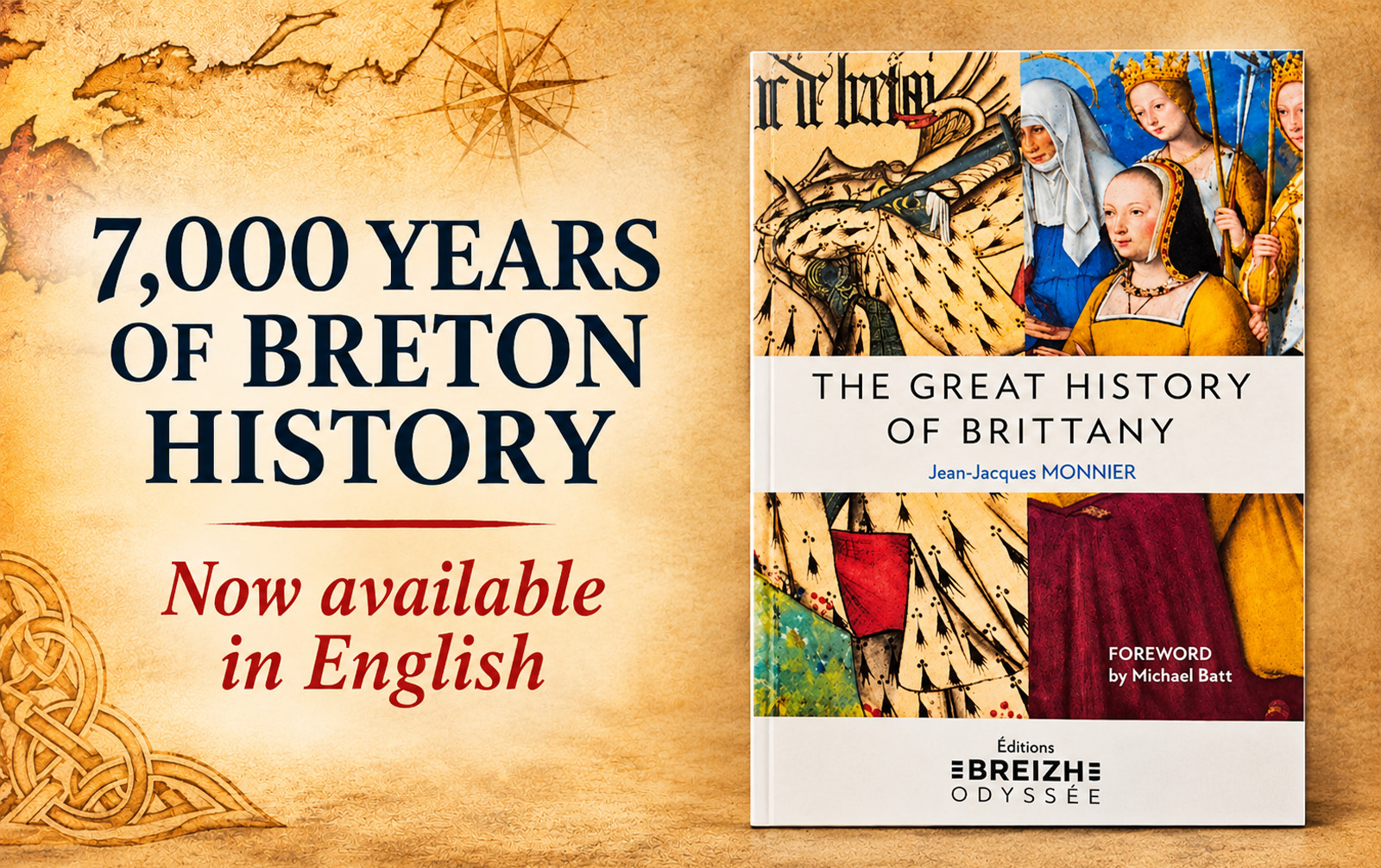
Readers can now explore in The Great History of Brittany.
Sommaire
The Great History of Brittany: 7,000 years of Breton History, now available in English
Brittany has a history stretching back thousands of years, from its remarkable prehistoric monuments to the challenges of the modern world. It was once a kingdom, then a sovereign duchy, before its annexation by the Kingdom of France in 1532. In 1789, the French Revolution brought the legal foundations of its remaining historic rights to an end. Yet Brittany’s story is far richer than these political turning points alone. With The Great History of Brittany, historian Jean-Jacques Monnier now brings this extraordinary journey to English-speaking readers, particularly those in the other Celtic nations.
Brittany: a Celtic country with 7,000 years of History
Today, Brittany is often associated with its coastline, festivals, music and traditions. Yet behind this familiar image lies a much longer story, shaped by prehistoric civilisations, Celtic migrations, independent rulers, maritime trade and profound social change.
For readers in Wales, Cornwall, Ireland, Scotland and the Isle of Man, many aspects of this history may strike a familiar chord.
Long before the emergence of the Breton kingdoms, the inhabitants of Armorica built some of Europe’s most remarkable prehistoric monuments. The standing stones of Carnac and the great passage tombs still bear witness to these ancient societies.
Centuries later, migrations from the island of Britain helped shape the language, culture and political development of Armorican Brittany.
Indeed, Breton belongs to the same branch of the Celtic language family as Welsh and Cornish. This linguistic connection remains one of the clearest reminders of the historic relationship between the two sides of the Channel.
However, Brittany is far more than its Celtic heritage. It has also experienced periods of political independence, economic prosperity, cultural renewal and profound transformation.
That is the wider story English-speaking readers can now explore in The Great History of Brittany.

From prehistoric Brittany to the modern era
Jean-Jacques Monnier takes readers on a journey spanning approximately 7,000 years, from the earliest monuments to contemporary Brittany.
His account begins with the prehistoric societies that left their mark on the Armorican landscape. Megalithic monuments, ancient settlements and early trading networks reveal a history that predates the arrival of Celtic-speaking peoples.
The narrative then explores the Celtic world, Roman Armorica and the migrations that helped establish Brittany’s distinctive language and identity.
During the ninth century, under Kings Nominoë, Erispoë and Salomon, Brittany entered a defining period of its History. It asserted its political independence from Frankish rule.
Over the following centuries, the Duchy of Brittany developed its own institutions, trading networks and diplomatic relationships. Despite repeated conflicts, it maintained a distinct political identity. Brittany also experienced periods of considerable prosperity. Its ports, maritime trade, agriculture and textile industries contributed to its influence across Europe.
In 1532, Brittany’s annexation by the Kingdom of France marked a fundamental turning point. The duchy lost its political sovereignty, although Brittany retained certain institutions and historic rights.
In 1789, the French Revolution brought another decisive break. The abolition of privileges undermined the legal foundations of Brittany’s remaining historic rights. Then, in 1790, the abolition of the old provinces brought its provincial institutions to an end.
Yet these events represent only part of Brittany’s long history.
Monnier’s account continues through the nineteenth and twentieth centuries, examining economic development, industrialisation, social change and the two World Wars.
It also explores the evolution of Breton culture, the challenges faced by the country’s languages and the movements that sought to preserve its distinctive identity.
Finally, the book brings readers into the modern era, offering historical context for understanding Brittany today.
A country shaped by the sea, its people and its culture
Throughout its history, Brittany has maintained close relationships with the Atlantic world.
Its geographical position encouraged maritime trade, fishing, exploration and exchanges with other European countries.
Breton sailors, merchants and explorers travelled far beyond their home ports. Among them was Jacques Cartier, whose voyages across the Atlantic in the sixteenth century connected Brittany with the history of North America.
Meanwhile, agriculture, textile production and maritime industries helped shape the country’s economic development.
During the nineteenth century, Breton onion sellers from the Roscoff / Rosko area became familiar figures in Britain. Known as the Johnnies, they maintained a remarkable commercial and cultural connection across the Channel.
However, Brittany’s History was not simply one of prosperity.
Wars, economic crises, emigration and major social changes also transformed the country. In particular, the French state’s policies of linguistic and administrative uniformity placed increasing pressure on Breton and other aspects of local culture.
The twentieth century brought further upheaval, including the two World Wars, economic modernisation and substantial demographic changes.
At the same time, cultural, linguistic and political movements worked to preserve and revitalise Breton identity.
Today, questions surrounding language, cultural transmission, economic development and political autonomy remain part of public debate.
By exploring these different dimensions, The Great History of Brittany helps readers understand how the past continues to influence the present.

Jean Jacques Monnier: a lifetime devoted to the History of Brittany
A Breton historian and the author of numerous publications, Jean Jacques Monnier has spent decades researching and sharing the History of Brittany.
In September 2024, he published La Grande Histoire de la Bretagne through Breizh Odyssée.
Richly illustrated, the 192-page French edition offers an overview arranged into five main sections and sixty short chapters.
Its purpose is to make the major stages of Brittany’s History accessible to a broad readership. Readers can follow the historical narrative without needing specialist academic knowledge.
He explained his wish to move beyond accounts that too often focus on Brittany’s supposed backwardness and difficulties.
Instead, he also wanted to highlight periods of prosperity, innovation and international influence.
However, this approach does not overlook conflict, crisis or failure. Rather, it offers a broader perspective on the many dimensions of Breton History.
The result is an accessible introduction to a complex past, from prehistoric societies to the transformations of contemporary Brittany.
This makes the book particularly valuable to international readers who may be unfamiliar with Brittany’s History.

From Breizh Odyssée to an international readership
La Grande Histoire de la Bretagne was originally associated with Breizh Odyssée, a centre dedicated to Breton History in Landevenneg, Finistère.
Opened in 2023, the centre offers visitors an immersive journey through the major periods of Brittany’s past.
The book extends that experience beyond the exhibition itself. It also allows readers to explore Breton history without travelling to Landevenneg. The original French edition appeared in 2024, followed by a Breton-language edition announced for 2025.
Then, in October 2026, an English edition appeared under the title The Great History of Brittany.
The English translation is by Alison Wall, while the foreword is written by archaeologist Michael Batt.
Published by Breizh Odyssée in association with HCB Histoire et Culture de Bretagne / ISB Istor ha Sevenadur Breizh, the new edition was presented at the Carhaix / Karaez Book Fair on 24 and 25 October 2026.
This publishing initiative reflects a commitment to making the History of Brittany accessible in several languages.
The French and Breton editions have already brought Brittany’s history to readers in both languages. Now, the English edition opens the door to a much wider international audience.” Now, the English edition opens the door to a much wider international audience.
It also creates new opportunities for cultural exchange between Brittany and the English-speaking world.
A book for readers across the Celtic nations
The significance of this English edition is particularly clear for readers in the other Celtic nations.
Brittany shares important linguistic, cultural and historical connections with Wales / Cymru, Cornwall, Ireland, Scotland and the Isle of Man.
Yet its history, especially beyond the medieval period, is often less familiar to international audiences.
The histories of these countries differ in many important respects. Nevertheless, they also raise questions that may resonate across the Celtic world.
How do languages survive through centuries of change? How are cultural traditions passed from one generation to another? And how do communities maintain their identities while adapting to the modern world?
Breton history offers its own answers to these questions. The book also introduces readers to figures and events rarely encountered in English-language accounts of European history.
From the prehistoric builders of Brittany’s megaliths to its medieval rulers, maritime explorers and modern cultural movements, readers encounter an exceptionally varied historical journey.
Brittany’s connections with the British Isles provide another fascinating thread.
Ancient migrations, maritime trade and cultural exchanges remind us that the English Channel has long been a route for people, ideas and commerce, rather than simply a dividing line.
For readers in the Celtic nations, The Great History of Brittany offers an opportunity to discover both a shared heritage and a distinct historical experience.
It should also appeal to anyone interested in European history, Atlantic connections and the survival of regional languages and cultures.

Brittany’s History deserves to be known around the world
The publication of The Great History of Brittany represents more than the translation of another history book.
It makes thousands of years of Breton history accessible to an international readership that has too rarely had the opportunity to explore it.
It also reminds us that Brittany cannot be reduced to its coastline, festivals or musical traditions. Behind these familiar images lies a long and complex history of prehistoric civilisations, kingdoms, a sovereign duchy, maritime prosperity, social transformation and cultural resilience.
For readers in Wales / Cymru, Scotland, Ireland, Cornwall and the Isle of Man, discovering this history may deepen their understanding of the connections between the Celtic nations.
For other English-speaking readers, the book offers an introduction to a country whose history deserves to be told on its own terms.
From the prehistoric monuments of Karnag to the Brittany of the twenty-first century, this is the story of a country shaped by thousands of years of history. With The Great History of Brittany, that story now has a new opportunity to reach the English-speaking world.
Discover The Great History of Brittany
Author: Jean Jacques Monnier
Title: The Great History of Brittany
English translation: Alison Wall
Foreword: Michael Batt, archaeologist
Publisher: Breizh Odyssée, in association with HCB Histoire et Culture de Bretagne / ISB Istor ha Sevenadur Breizh
Publication: October 2026