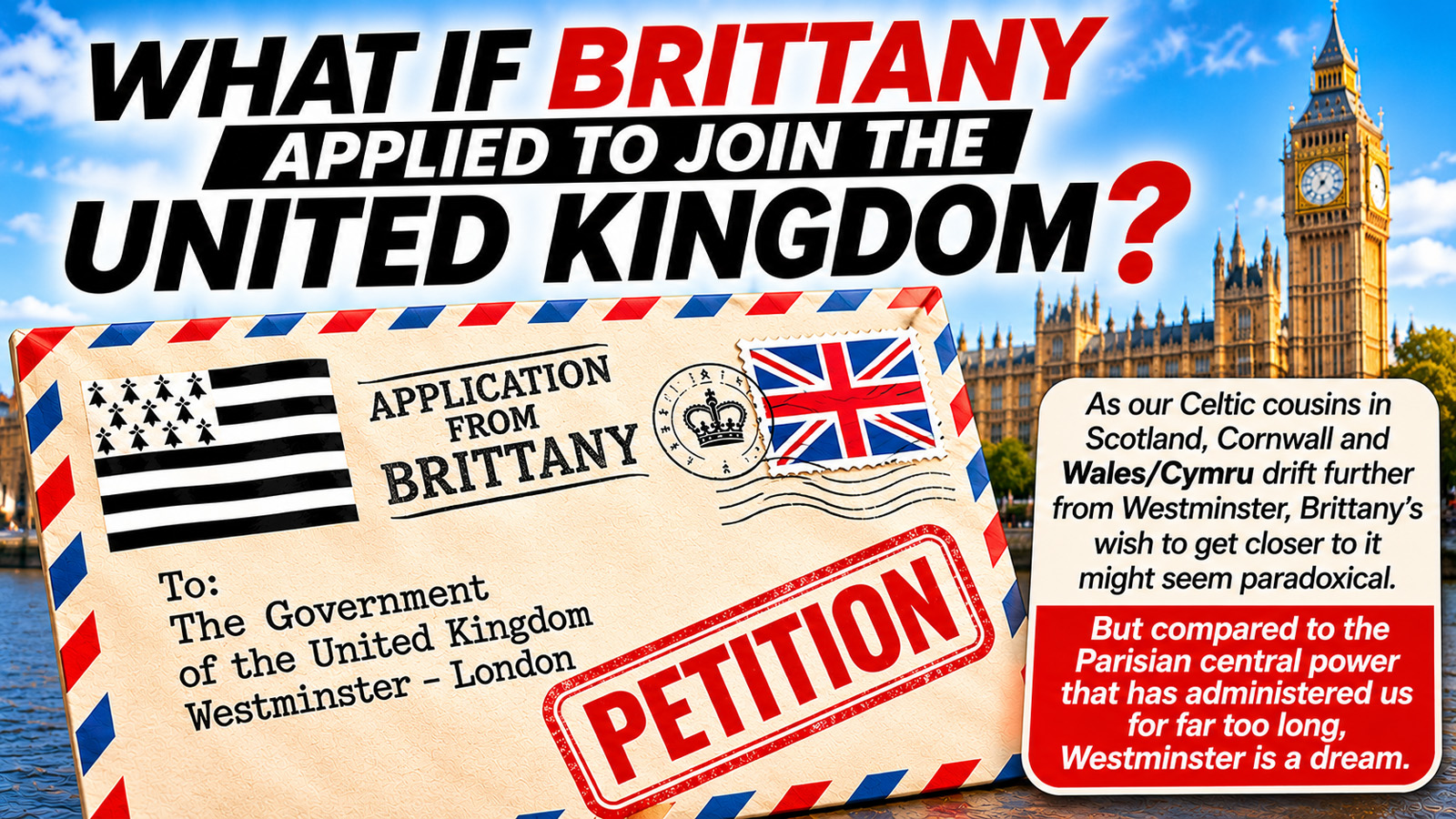
What if Brittany applied to join the United Kingdom?
The idea might sound completely absurd. Some people will smile, while others may be rather less amused. Yet behind this deliberately provocative proposal lies a serious political question.
Why shouldn’t Brittany enjoy, at the very least, a degree of autonomy comparable to that of Scotland or Wales?
NHU Bretagne is therefore proposing an unusual petition, combining British humour with a serious democratic debate.
It will be addressed to Bretons and to our neighbours across the Channel. After all, we share far more than a stretch of sea and a few centuries of History. Perhaps it is time to look towards London in order to ask some awkward questions of Paris.
Sommaire
Brittany joining the United Kingdom: why not?
Imagine, for a moment, a Breton delegation arriving in London. Its members would politely request that Brittany be admitted to the United Kingdom, subject to a few conditions. A Breton Parliament, a government and genuine decision-making powers would be high on the list. After all, Scotland and Wales already have such institutions. Why should Brittany have to do without them?
Admittedly, a few minor details would need sorting out. Borders, currency, relations with Paris and the consequences of Brexit might complicate negotiations somewhat. Not to mention the question of whether the British would actually be interested! But the Bretons have survived enough turbulent centuries not to be frightened by a little administrative complexity. After Brexit, why not imagine a Breizh-in?
The idea is amusing. Nevertheless, it raises a much more serious issue. After centuries of occasionally turbulent relations with the English, would the Bretons really have to ask London for powers that Paris refuses to grant them? Our ancestors might find that rather entertaining.
Little Brittany and Great Britain: a family history
There is a historical detail that is sometimes overlooked. Continental Brittany was long known as Little Britain, to distinguish it from the island of Great Britain. These names reflect a history deeply connected with migration and exchanges across the Channel. They certainly do not imply that one Brittany was subordinate to the other. Instead, they remind us of an exceptionally old historical relationship.
So, if one is Little Britain and the other Great Britain, why not imagine a grand family reunion? The question is whether London would be willing to welcome its cousins from Armorica! More importantly, would those cousins really have to cross the Channel to gain greater political freedom? Behind the joke lies a very real shared history.
Historical ties across the Channel
Brittany owes its name and much of its cultural heritage to migrations from the island of Britain during the early Middle Ages. These movements of people helped transform Armorica. They also strengthened connections with the Brittonic populations of what are now Wales and Cornwall. Maritime, religious, commercial and personal exchanges subsequently maintained those relationships. For centuries, the Channel was as much a route of communication as a dividing line.
Relations with Ireland and Scotland also form part of this wider Celtic history. They developed along different paths, particularly through religious and cultural exchanges. Consequently, the connections between the Celtic nations are not simply the product of modern festivals. They rest on centuries of contact and, in some cases, much older shared traditions.
Languages that tell the story of an ancient relationship
Breton, Welsh and Cornish belong to the Brittonic branch of the Celtic languages. Their linguistic relationship is therefore particularly close. Irish and Scottish Gaelic belong to the Goidelic branch of the same language family. All these languages share Celtic origins, although they have developed in different ways. Together, they reflect a cultural history that extends far beyond today’s political borders.
The relationship between Breton, Welsh and Cornish is especially striking. It reminds us that Brittany did not develop solely through its connections with continental Europe. Its history also looks towards the Atlantic and the British Isles. In this respect, our Celtic cousins occupy a distinctive place in our heritage.
Genetics also reveals ancient connections
Recent genetic research offers another perspective. A study published in 2024 in the scientific journal Nature Communications examined the genetic structure of populations in north-western France. It identified distinctive features within Brittany and genetic affinities with certain populations of the British Isles. These findings contribute to our understanding of ancient population movements. They also reinforce the historical importance of connections between Brittany and the Brittonic world.
However, it would be misleading to suggest that all Celtic populations share an identical genetic background. Ireland, Scotland, Wales and Cornwall each have their own complex demographic histories. Moreover, Breton populations have maintained continuous relationships with their continental neighbours. Genetics determines neither political identity nor cultural belonging. It simply adds another dimension to an already rich history.
Historically, linguistically and, in certain genetic comparisons, Bretons therefore share particularly close connections with their Celtic cousins. These affinities cannot be reduced to their relationships with neighbouring Romance-language populations. After all, the Channel may separate our shores, but it has never erased our shared history.
Scotland and Wales / Cymru: nations that make their own decisions
Beyond these historical connections lies an important institutional difference. Scotland and Wales / Cymru have their own Parliaments and governments. Their powers are not identical, but they can make many decisions without constantly referring to London. This arrangement has not brought about the disappearance of the United Kingdom. Instead, it has recognised distinct political powers for several of its nations.
Scotland: a Parliament, a government and tax-raising powers
Since 1999, Scotland has had its own Parliament in Edinburgh / Dùn Èideann.
It can pass legislation in numerous areas, including health, education, housing and justice. The Scottish Government manages public policies within those responsibilities. It is accountable to the Scottish Parliament. Scottish citizens therefore have institutions capable of making major political decisions.
Scottish autonomy also extends to certain aspects of taxation. The Scottish Parliament can set rates and bands of income tax on non-savings, non-dividend income. It also has powers over several specific taxes. Of course, Westminster retains essential responsibilities, including defence and foreign affairs. Nevertheless, tax decisions made in Edinburgh can have direct consequences for Scottish taxpayers.
This provides a particularly concrete example. Why can Edinburgh /Dùn Èideann make certain tax decisions for Scotland, while Rennes has no comparable powers for Brittany? The question deserves more than an answer based solely on French administrative tradition.
Wales: autonomy strengthened step by step
Wales also has its own Parliament, the Senedd, based in Cardiff / Caerdydd. Since 1999, its powers have gradually evolved. Welsh institutions are responsible for important areas, including health, education, transport and language policy. The Welsh Government therefore has genuine scope for political action. This autonomy has developed through successive institutional reforms.
However, Welsh powers differ from those exercised in Scotland. The justice system, for example, remains largely shared between England and Wales / Cymru. Certain tax powers have also been transferred, although their scope differs from the Scottish model. There is therefore more than one form of autonomy within the United Kingdom. And none of these arrangements rules out further change.
Meanwhile, what can Brittany actually decide?
The comparison between Brittany and the United Kingdom becomes particularly revealing when we examine the powers of Breton institutions.
Brittany does have an elected Regional Council. It is responsible for areas including regional transport, secondary school buildings, vocational training and economic development. These responsibilities are important and involve substantial budgets. Nevertheless, they remain far removed from the political powers exercised in Edinburgh / Dùn Èideann or Cardiff / Caerdydd.
The Regional Council of Brittany has no general legislative powers comparable to those of the Scottish Parliament or the Senedd. Its responsibilities are defined by French legislation. Furthermore, its ability to raise taxes and determine its own financial resources is limited. Much of its funding depends on mechanisms established by the French central government. The institutional gap is therefore considerable.
This does not mean that Breton elected representatives decide nothing. They have genuine responsibilities and make important decisions every day. However, they cannot independently legislate across major areas of public life. Health, justice, taxation and the general organisation of education largely remain under other levels of government. This is precisely the difference our petition seeks to highlight.
A Brittany still divided administratively
There is another peculiarity that our British neighbours may find difficult to understand. Historic Brittany comprises five departments: Côtes d’Armor, Finistère, Ille et Vilaine, Loire Atlantique and Morbihan. Yet the present administrative region includes only four of them. Loire Atlantique, which includes Nantes / Naoned, remains part of the Pays de la Loire administrative region. This division persists despite the historical, economic and cultural ties linking it to the rest of Brittany.
This raises an obvious question. How can Brittany’s institutional future be considered without addressing its reunification? Would Breton autonomy truly make sense if it excluded Nantes / Naoned and Loire Atlantique?
For NHU Bretagne, the debate naturally concerns all five departments of historic Brittany.
Would Bretons really have to cross the Channel to gain autonomy?
This is where the irony of our proposal becomes clear. To obtain a Parliament with genuine powers, would Bretons have to become British? Would they need to ask London for what Paris appears unwilling to grant them? The question is deliberately provocative. Yet it highlights a very real institutional contrast.
Naturally, the historical and constitutional circumstances are different. The United Kingdom does not operate according to the same principles as the French Republic.
But is that difference sufficient reason to dismiss any discussion of Breton autonomy? Several European states have forms of political autonomy, sometimes very extensive. Spain, Italy, Germany, Finland … provide different examples of institutional arrangements.
Why shouldn’t Brittany have powers suited to its history, economy and the expectations of its people?
Why should decisions about languages, education, transport or certain fiscal policies remain so heavily dependent on the central government? Above all, why shouldn’t Bretons be able to choose their own political arrangements democratically? Autonomy would, at the very least, provide an initial answer. It would not prejudge any institutional choices Bretons might subsequently make.
We are not asking the British to govern us. We are asking why Bretons should not be able to govern themselves.
Dear British neighbours, would you welcome the Bretons?
Since we are entertaining this possibility, we might as well put the question directly to our neighbours.
Dear British friends, would you consider welcoming five additional Breton departments, with five millions people?
Don’t worry, we would not arrive empty-handed! We would bring our ports, maritime economy, businesses, languages and a remarkably vibrant culture. Not to mention a few firmly held convictions about our identity and our future.
Admittedly, a few details would probably need negotiating with London. The Scots and the Welsh might also wish to have a say. As for the Cornish, they might be delighted to be reunited with their cousins across the Channel. The Irish, meanwhile, might watch the whole affair with particular amusement. And Paris might suddenly discover a renewed interest in Breton autonomy!
After Brexit, here comes Breizh-in. The expression has, of course, no legal significance whatsoever. But it might at least raise a smile while posing a political question. Sometimes humour can open debates that formal political speeches have failed to begin.
NHU Bretagne proposes a petition: Breizh-in!
It is in this spirit that NHU Bretagne is preparing a petition with a deliberately unexpected title: « What if Brittany joined the United Kingdom? »
Its purpose is not to make an official request for British annexation. This is a symbolic, humorous and democratic initiative. It seeks to draw attention to the gap between the powers enjoyed by Scottish and Welsh institutions and those available to Brittany. Behind the joke, the question of Breton autonomy remains entirely serious.
The petition will be addressed to people living in historic Brittany, as well as to our British neighbours. It will be available in French and English. Everyone will therefore have the opportunity to support a genuine debate about Brittany’s institutional future. And, naturally, there will be no need to actually want to become British in order to sign!
One petition, two languages and an international debate
To give this initiative its full reach, NHU Bretagne is also publishing a French-language version of this article.
It presents the debate directly to Breton and French-speaking readers. Scottish, Welsh, Cornish and English readers may have different perspectives on the constitutional questions involved. Their experiences and reactions could enrich the discussion. After all, a debate about Breton autonomy need not stop at Brittany’s borders.
We also wish to encourage discussion among our own readers. Would an autonomous Brittany within the present French state be sufficient? Should considerably greater powers be considered? Or should Bretons be free to choose an entirely different institutional future? These questions deserve an open public debate, without taboos or predetermined answers.
LIRE CET ARTICLE EN FRANÇAIS – ET SI LA BRETAGNE REJOIGNAIT LE ROYAUME-UNI ?
Brittany in the United Kingdom? What if the real question lies elsewhere?
Ultimately, our proposal raises a much deeper question than its title might suggest. Brittany has its own history, languages, culture and economy. Yet its people have limited institutional means to determine their collective future. Scotland and Wales demonstrate that different political arrangements are possible. Their models are neither perfect nor directly transferable, but they certainly deserve consideration.
So, must Brittany really apply to join the United Kingdom to open a debate about Breton autonomy?
Probably not. However, if our proposal raises a smile in London, encourages reflection in Cardiff, attracts interest in Edinburgh and causes a little discomfort in Paris, it will already have achieved part of its purpose. Behind the joke lies an essential question: who should decide Brittany’s future?
Brittany in the United Kingdom? Perhaps not. An autonomous Brittany? At the very least!
What do you think?
An editorial initiative by NHU Bretagne